
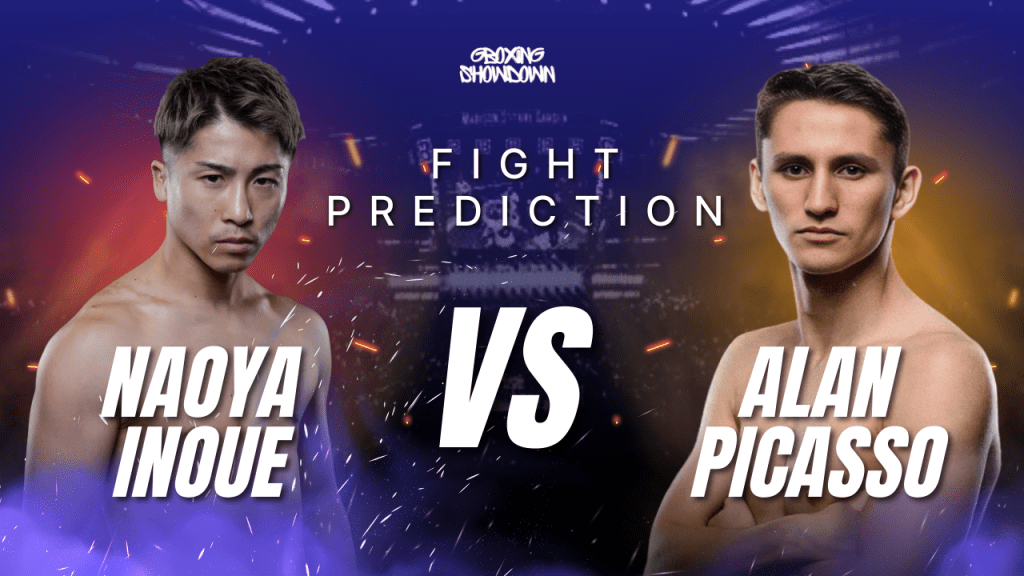
Naoya «Monster» Inoue and Alan David «Rey» Picasso at «The Ring V: Night of the Samurai» promises to be one of the most technical and tense fights of the end of the year, with the Japanese defending his undisputed Super Bantamweight titles against an undefeated WBC number one ranked challenger. Beyond Inoue’s superstar aura, Picasso arrives as a tall, young, and in-form opponent, representing the classic clash between Japanese precision and Mexican creativity.
The fight is scheduled for December 27th at the Mohammed Abdo Arena in Riyadh, Saudi Arabia, within the framework of Riyadh Season, which adds a global and media component ideal for fans and for content creators of boxing predictions and news. It is a perfect setting to generate conversation on platforms such as a YouTube Channel dedicated to technical analysis, as the fight pits two undefeated boxers at their professional peak.
Analysis of Naoya Inoue
Naoya Inoue arrives as the undisputed Super Bantamweight champion, with an immaculate record hovering around thirty victories and a very high proportion of knockout wins, solidifying him as one of the best pound-for-pound fighters in the world. His style is that of a high-level boxer-puncher: he combines tense movement, an almost surgical reading of timing, and explosive short punches to the body and head.
Among his main strengths are his timing, precision in counterattacks, and the ability to end fights with a single clean combination, even against elite rivals. Furthermore, his experience in unification bouts and title defenses gives him a competitive calmness that very few can match, having already overcome numerous distinct styles and maximum-pressure situations.
His potential weaknesses for this duel stem from the difference in size and reach with Picasso, a taller opponent with longer arms, as well as the logical wear and tear of a career with so many demanding duels. He may also be forced to work harder than usual to close the distance, which opens small windows for receiving jabs and counter punches while he cuts off the ring.
In terms of fight pace, Inoue usually starts by measuring a lot in the initial rounds, analyzing the opponent’s reactions, guards, and patterns, before progressively accelerating. His latest appearances have been characterized by almost total control of the fight’s narrative, alternating moments of aggression with phases of retreating boxing that unsettle the opponent.
Analysis of Alan David Picasso
Alan David «Rey» Picasso arrives as an undefeated Mexican with over thirty professional fights, with only one draw and no defeats in the paid ranks, and holds the WBC number one spot in the division. He is close to 1.73m (5’8″) in height and has a greater reach than many rivals in the category, allowing him to work comfortably from mid-to-long range with an active jab.
His style is based on solid fundamentals: a good jab, a combination of body and head shots, and a disciplined guard for a relatively young Mexican boxer. He is not a demolishing knockout artist, but he does have a respectable number of victories before the limit, usually built on volume, increasing precision, and progressive wear.
As strengths, Picasso brings size, youth, physical condition, and maximum motivation: defeating a figure like Inoue would immediately catapult him into the global elite. Additionally, his recent close victory against Japanese rivals gives him some experience in dealing with Nippon styles, though none of Inoue’s caliber.
Among his weaknesses is the fact that he has not yet faced a champion with the technical level, power, and pace that the Japanese fighter handles, which implies a very large jump in opposition. Defensively, while he is tidy, he tends to remain static on the center line during some exchanges, which is an enormous risk against a clinical puncher like Inoue.
In terms of fight pace, Picasso usually combines phases of disciplined boxing at a distance with moments of exchange in the middle range, where he seeks to impose his physique and punch volume. His recent performances have been confidence-boosting victories, but they have also shown that he can concede close rounds when the opponent has good mobility and a responsive jab.
Direct Style Comparison
Timing: Inoue has a clear advantage in timing, as his ability to find openings and punish minimal errors is one of the hallmarks of his boxing, proven against established champions. Picasso, although he has a good sense of time for placing the jab and combinations, has not yet demonstrated that level of reading against the type of opposition he will see in Riyadh.
Distance Control: Picasso arrives with better physical tools to set the distance thanks to his height and reach, provided he maintains discipline in the use of the jab and footwork. However, Inoue has repeatedly shown that he knows how to cut off the ring against bigger opponents based on feints, changes of pace, and diagonal attacks, which balances this aspect.
Defense and KO Power: Defensively, Inoue combines an effective high guard with short torso movements and lateral steps that allow him to move off the line after punching. Picasso is correct in his defense, but more linear and less experienced in maximum-pressure scenarios, which can be costly against fast combinations. In KO power, the scale clearly tips towards Inoue, whose knockout rate and quality of wins before the limit against top champions make him the most dangerous puncher in the division.
Style Matchup: The clash is shaping up to be a duel where Picasso will try to box long and control the terrain with the jab, while Inoue will seek to close the distance to punish the body and surprise with straight hands and short hooks. If the Mexican fails to impose his stature from the start, the fight could become an ideal scenario for the Japanese to set the pace with his precision and body work.
Possible Fight Scenarios
Fight on Points (Decision)
If the fight extends to the scorecards, the highest probability is that Inoue will be ahead, having established the initiative and the clearest moments of the contest. His ability to close rounds strong and his clarity to the judges’ eyes in power shots are usually decisive in close duels.
Picasso could opt for a very conservative strategy, prioritizing the jab, movement, and clinching at close range, to minimize exchanges and try to steal rounds through volume and distance control. Even so, he would need an almost perfect performance, avoiding falling into the trap of exchanging in the mid-range, where Inoue lands higher quality impacts.
In a decision scenario, the most realistic script would be a victory on the scorecards for Inoue, with Picasso having some successful moments when he manages to keep the fight in the center of the ring and sticks to his tactical plan.
KO or TKO
The knockout scenario clearly favors Inoue, who has shown he can finish fights with a single well-placed punch or with body flurries that gradually wear down the opponent. The passages where Picasso remains on the center line, especially after throwing long combinations, are a perfect window for explosive counters from the Japanese.
Picasso also has options for TKO if he manages to systematically punish with his jab and straight hands from afar, opening cuts or causing unexpected wear on Inoue through volume and size. It is not the primary scenario, but it is a real risk if the champion gets overconfident or underestimates the challenger in long exchanges.
Alternative Scenarios and Surprises
The fight could be complicated by factors such as cuts in the eye area, resulting from head clashes or jab precision, which would add drama and force tactical adjustments on the fly. A deep cut on Inoue, for example, could accelerate his offensive pace and make the fight more chaotic than planned.
Another variable is the mental wear on Picasso facing a global star for the first time in a high-pressure media setting, which could make him hesitate between boxing conservatively or taking risks to try and surprise. There is also the possibility that the Mexican’s size and youth force Inoue to manage his energy better, causing the Japanese to pace himself more than usual in certain stretches.
Final Prediction
Evaluating styles, experience, power, and previous opposition level, the most solid prediction is a victory for Naoya Inoue. Picasso has the physical tools and competitive hunger to offer resistance and win some rounds, but he is taking an enormous leap in level against one of the best finishers in modern boxing.
The scenario chosen as the main prediction is Inoue winning by unanimous decision, in a fight where the Mexican manages to survive thanks to his size, tactical discipline, and pride, but without being able to match the champion’s precision and power. A plausible margin on the scorecards would be around 116-112 or 117-111, reflecting competitive rounds, but with a clear winner based on punch quality and control of key moments.
As a secondary path, a late TKO by Inoue between rounds 9 and 11 cannot be ruled out, generated by the accumulated wear on Picasso’s body and a finishing blow to the face after the Mexican begins to lose mobility. However, for the purpose of a firm prediction for this analysis, we opt for: Naoya Inoue wins by decision after a demanding but generally controlled battle by the Japanese monarch.
«Inoue vs Picasso» at «The Ring V: Night of the Samurai» is shaping up as a clash of generations and schools: Japanese technical perfection against Mexican discipline and pride, with world titles and legacy at stake. The result could mark the immediate future of the Super Bantamweight division and open discussions about Inoue’s new challenges in higher weight classes or Picasso’s definitive emergence onto the elite scene.
For fans who closely follow the latest news and seek detailed predictions, this fight offers perfect material for pre-fight analysis, recaps, and post-fight debates on any specialized boxing YouTube Channel. Whether by decision or knockout, the night of December 27th in Riyadh will be a must-see event for those who enjoy high-level boxing and want to understand how tactical nuances decide fights between undefeated competitors.